Monday, 27 November 2023

Utiliser uniquement la théorie française pour analyser une émission de télévision française


Using only French theory to understand the opening sequence (pre-credits and credits sequence)


Without wishing to be too stereotypical, Les Revenants is a French show, and France is the land of semiotics, deconstruction, and all that good stuff!

A hardcore analysis of the opening sequence using every French theorist we’ve studied (Barthes, Levi-Strauss, Baudrillard)


  1. Barthes - semiotics, the study of meaning: everything means something!
  2. Levi-Strauss - where oppositions construct meaning 
  3. Baudrillard - postmodernism: nothing is real and meaning has collapsed, hyperreality, where the representation is more real than the thing being represented 

Analysis


  • The opening sequence is completely predicated on foreshadowing the events and themes of the TV show. In particular, the arresting image of a butterfly bursting out of a display cabinet encodes the themes of supernatural mystery, and the dead coming back to life, and the fragility of life. Additionally, the MES of the butterfly’s fragile wings functions as a symbolic code for fragility, and overcoming one’s problems, which are core themes of the show 
  • Camille’s depression is both constructed and reinforced through the anchorage of the close up shot of her staring miserably out of the coach window. This forms a binary opposition between her and the lively students who surround her, and even goes to reinforce the themes of depression, fragility and death 
  • A binary opposition is constructed between a young couple kissing passionately in overgrown grass, and a set of two crude grave markings that suggest a dead couple. This unsettling binary opposition proairetically refers to many events in the show, and makes clear the relationship between sex and death 
  • The shot of invisible children playing reflected in a pool not only emphasises and subverts  themes of life and death, but also introduces the symbolic motif of reflections. Here reflections symbolise the supernatural, and also the duality of life and death, the potential paths of life left untraveled, and other deeply philosophical aspects
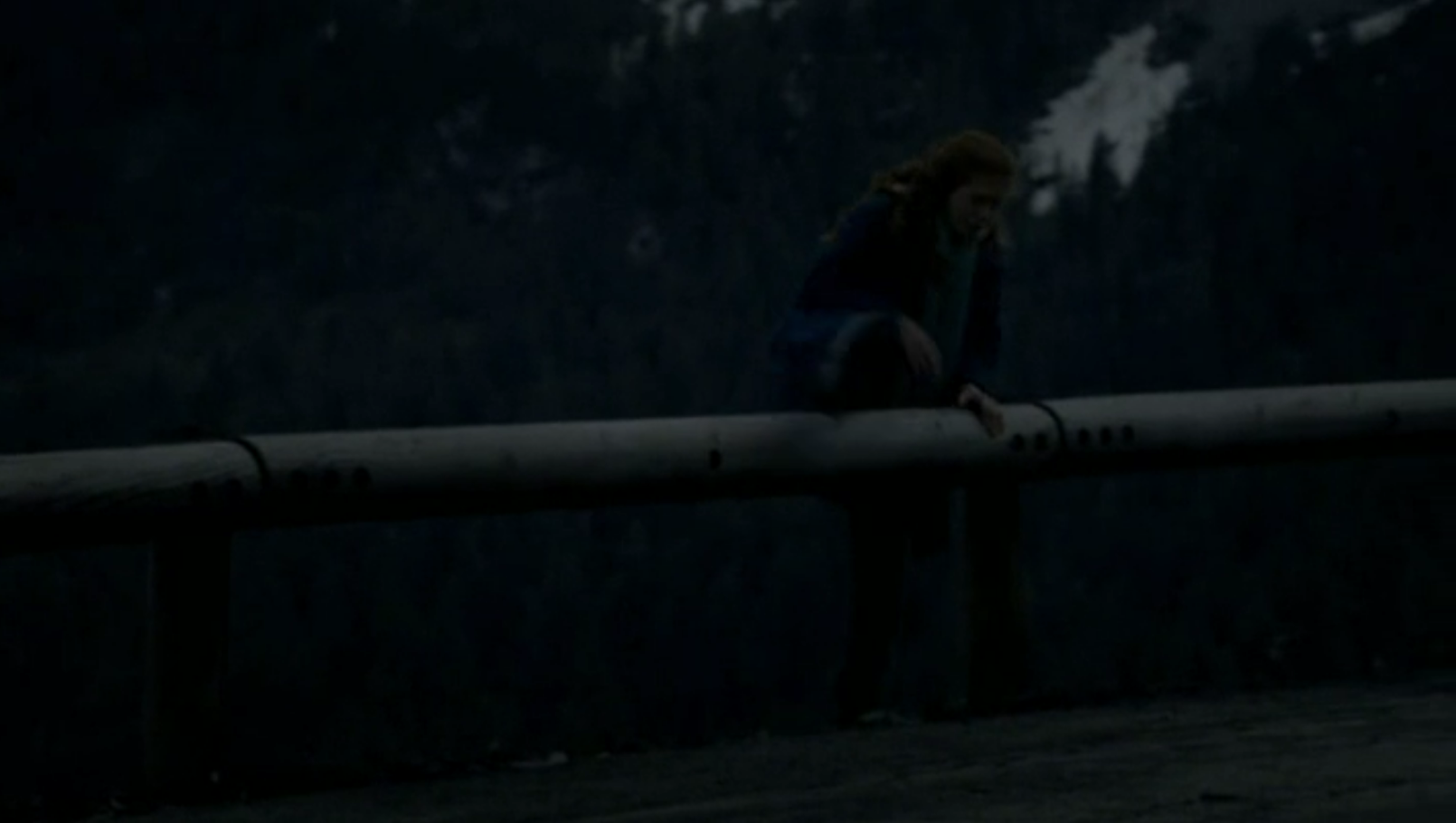
  • The mid shot of Camille clumsily climbing over a barrier situates her in an unexpected and highly liminal setting. Far from a stereotypical location we would expect to find a teenage girl, her isolation constructs a hyperreal representation of a motorway at night, an experience that few of the audience will ever experience, that positions the audience in a deeply confusing and interrogative  mode of address. Camille is positioned as and with the audience. She is passive, confused, and has no knowledge of the narrative. Arguably, Camille’s resurrection is a highly postmodern narrative occurrence, as it draws attention to the fact that nothing is real and nothing matters, Instead we are left to be confused and to simply go along with the narrative. 
  • Through the complex and contradictory series of images in the opening sequence, the audience are left unable to make sense of what is alive or what is dead, or even what is real and what is not real. Instead, a highly fractured, confusing and postmodern narrative is presented where audiences must instead make their own conclusion
  • Additionally, themes of madness, psychosis are presented through a series of confusing and postmodern images. For example, the fantastical shot of a delicate and dead butterfly bursting forth from behind hard glass constructs a contradictory and infuriating visual motif, with symbolic themes of madness, control, destiny, and lack of free will. Additionally, the physical impossibility of a butterfly breaking glass with it’s soft wings symbolically and proairetically reinforces the various impossible themes that manifest itself in this show. 
  • The long shot of the coach serenely falling off the side of the dam creates an unexpected mode of address that seems completely at odds with the expectations of the audience. The audience are instead denied the reactions of the children before they die, which constructs a deliberately anticlimactic atmosphere for the audience. This bizarre use of hermeneutic codes confirms for the audience that this show will make extensive use of enigmas, and will be very mysterious. 
  • The shot of the school children discussing their frustration of having to complete homework on a school trip is made in close up to emphasise the frustration of the cast of characters. This use of symbolic codes briefly creates a relatable mode of address for the target audience, and serves to  humanise the cast of characters. However we instantly cut to alienating and disconnecting long shot of the coach trundling over the edge of the cliff. This montage constructs an ideology that life is pointless, and that we could die at any moment. This highly postmodern construction of meaning instantly communicates to the audience the nihilistic nature of this show 
  • A binary opposition is constructed in the opening sequence between the horror of the coach of children crashing, and the beautiful setting of the alps. The nature of this binary opposition is to emphasise the horror of the crash, and to make clear to the audience it’s emotional impact
  • Another binary opposition is constructed through the montage of shots within the coach that show Camille, isolated and lonely, with the conversations of the other students. This brief montage expertly constructs Camille’s character to the audience, and allows us to understand her place within the narrative 
  • The MES of the dead deer floating in the lake in the opening titles constructs a powerful proairetic code. Perhaps an intertextual reference top the Disney film Bambi, the juxtaposition between life and death, innocence and experience, and beauty and decomposition construct an alarming polysemic array of meaning for the target audience
  • A binary opposition between life and death is constructed through the slow tracking shot that moves between a young couple kissing in a field, and two simple graves. Not only does this foreshadow the themes of life going on in spite of death, it also infers that sex and death will be essential themes to this show

What makes Les Revenants stereotypically French?


  1. It is quiet, muted, depressing, and flat 
  2. Abstract themes based around symbolism and semiotics 
  3. There’s lots opf smoking!
  4. There’s lots of sex!
  5. Dark, depressing, moody themes

In medias res - in the middle of the action


Cold opening - thrown in to the action with no context 

Les Revenants - initial discussion, including narrative applications

Initial discussion: what the hell is going on?


“Are you going to tell us what’s going on?”
“I would if I could!”


Les Revs is a narrative that is completely based on mysteries, enigmas, and hermeneutic codes. Its narrative is predicated on the fact that not all mysteries will be elaborated to the audience. Potentially this can be very frustrating, and suggests a niche and specialised audience

The genre of the first episode is unclear. Comprising a number of genre conventions from a range of completely different sources, the show is very difficult to categorise, which means designating a target audience is also difficult.

However, with it’s themes of characters coming back from the dead to ‘terrorise’ a small town, the show is arguably a classic example of a zombie narrative, albeit a highly unconventional one

A highly confusing narrative, completely based on hermeneutic codes is established to the audience. However, in the closing montage, the audience learns a range of facts that helps them to make some conclusions about the narrative. 

However, like many TV serials there are a number of hermeneutic codes left unresolved in a  cliffhanger scenario. These include: who is Victor? What happened to the girl? How did they come back? Why was victor just standing there? Why was she freaking out on the bus???

Les Revs is less of a conventional narrative and more of a puzzle that is based on feelings, emotions rather than trying to tell a conventional story. For example, in the final montage we cross cut between Lena losing her virginity and Camille having a panic attack in a coach. The audience must come up with their own interpretation of this scene: whether Camille is somehow psychically bonded to Lena and is experiencing sexual intercourse or she has foretold that the coach is about to crash. This complete lack of anchorage gives the audience complete freedom to create their own meaning. This is highly divisive and again appeals to  a niche audience

However, which the show is highly mysterious,, it still is generally conventional of the mystery/drama genre 

The show is about grief, death, madness and sex, all of which are huge and difficult situations to comprehend. For example Mr Costa is so traumatised by his wife’s return, he murders her, which is a difficult thing for many audiences to comprehend. Yet the most difficult thing to comprehend is that in this world, people come back from the dead. This deeply philosophical mode of address will appeal to certain audiences, and completely alienate others. 

A highly suspenseful and confusing narrative that provides a challenging experience for the target audiences

Suspense: where information or a conclusion is withheld from the audience. Les Revenants is completely based on strategically withholding information from the audience. 

One possible response would be to be intrigued in satisfying way. Yet other audiences may be frustrated or ‘weirded out’ by the show’s absolutely bizarre mode of address

The central premise is strange and alienating to the target audience. On the one hand, the show is arguably a fairly typical zombie narrative. Yet on the other hand, generically, les revs is highly unconventional, lacking conventions such as zombies eating people, extreme moments of gore, and pale dead skin. Potentially this provides audiences with an exciting and positive experience. Steve Neale argues that genre is based on a system of repetition and difference, and potentially Les Revs provides a unique experience to the audience

Character’s motivations and narrative elements are often left unclear to the audience. For example, the narrative thread involving MR and Mrs Costa is highly troubling, mysterious and problematic for the audience. It is heavily…

The central premise of this depressing and moody series is that the certainty of death itself has been reversed. Far from being an exciting and delightful circumstances, the characters universally react with confusing, fear, misery and distress

Les Revs is completely based around hermeneutic codes. What is going on? Where is this going? Why are people coming back from the dead? What determines if someone comes back? What was that twin thing about? 

The final sequence is suspiring and distressing for audiences in a variety of different ways. Camille, apparently psychically linked to Lena, experiences Lena losing her virginity, however Camille experiences something completely out of context, has an enormous panic attack, and then dies. The ending to this episode is extremely confusing

The show provokes many questions, and positions the audience in a highly active and participatory mode of address. Les Revs is not a show that can be enjoyed passively, but instead is completely predicated on active audience engagement. This actively addresses an educated target audience 

However, there are many aspects of this show which could appeal to a broader audience. The supernatural horror elements may of course appeal to genre fans, and a range of interesting and attractive characters. Finally the setting, shot in the French alps provides audiences with a visually pleasing setting

The setting is beautiful and intriguing, and also highly atypical of a supernatural horror. It provides an isolating mode of address that completely goes against the typical Parisian setting favoured by many French set productions that attempt to appeal to an international audience. It is also partly funded by the Alps tourism board


Applying narrative theory


Todorovian approaches - of limited use

Todorov argued that narratives move between a state of equilibrium (balance) and disruption/disequilibrium or un-balance. Examples of disruption include

  • Mr Costa burning down the house
  • The bus crashing 
  • An ugly memorial is being complained 
  • Victor arrives!
  • Camille is forced to go on the school trip (and die)
  • The bartender is murdered 
  • Camille come back!
  • Lena loses her virginity
  • Claire and thingy get divorced 
  • Mr Costa’s suicide
  • EVERYONE COMES BACK
  • A relationship is established between Lena’s dad and the barmaid
  • Simon turns up!

Conclusion

Todorov’s theory is of limited use here , as disequilibrium occurs constantly throughout the narrative. And for many characters, their disequilibrium is actually another character's equilibrium! A good example of this is Victor forcing his way in to Julie's house. Now the little (scary) boy has a new home, a new mother, and a new equilibrium. However for Julie, suddenly having a (creepy) child is a massively disruptive disequilibrium. So in order to apply this theory, we must stretch it to its extreme!

Single strand or multi strand? - It's totally multi strand!

Unlike San Junipero, which by and large follows a single narrative strand (Yorkie and Kelly), Les Revenants instead works as a highly complex and detailed multi strand narrative. Different character's narratives criss cross with each other's, creating a satisfying yet decodable mess of separate narratives.

A diagram of the various narrative strands of episode one of Les Revenants

Here's a few:

  • Camille comes back and freaks out her family 
  • Simon comes back and looks for Adele
  • Julie is forced to ‘adopt’ victor
  • Julie’s next door neighbour is a flirt
  • Victor crashes the bus (???)
  • Lena and Camille’s twin thing
  • Mr Costa kills his wife and himself 
  • Claire’s new husband 

The range of various sub narratives can engage a range of different audiences!

Linear, non-linear or cyclical narrative?

Technically it's a mom-linear narrative. There are two 'flash points', with a flash forward occurring after the initial cold opening (where the children die on the coach, very shocking and surprising!), followed by a cut to the intertitle 'present day', which many audiences may quickly disregard since Camille is instantly seen walking around in the dark near the coach crash. No one would suspect any time had passed, surely? Then the rest of the episode proceeds in a straightforward manner, cutting between a range of narrative strands in a linear manner over the course of a single evening/night. But then we cut back to five years earlier, with the alarming scene that cross cuts between Lena loosing her virginity and Camille dying in terror. And since the episode ends with a bus crash, the episode is ALSO cyclical: it ends where it starts. Yet also, as a serial, we as an audience understand that these narrative enigmas will potentially be resolved next time. Therefore, the terrifying POV shot of the bus serenely falling off the cliff also functions as a very real 'cliff hanger' ending!

Wednesday, 22 November 2023

I, Daniel Blake - regulation and distribution of independent cinema

 What makes I Daniel Blake an independent film?

  • A complete lack of recognisable actors indicates the film has lower production values and a lower budget than a mainstream film. However, this ultimately work’s to the film’s advantage by constructing a more relatable and hard hitting mode of address.
  • Additionally, the actors cast in this film are far from glamorous, and are not hegemonically attractive. This makes the film more relatable to a working class audience
  • The setting is ‘real’ with the majority of scenes being shot on location, as opposed to being shot in a soundstage or studio. His makes shooting significantly more difficult, yet is also makes the film far more realistic, and far cheaper too
  • The film was not made by a well known production company such as Marvel Studios. Yet was produced and distributed by s number of smaller companies in order to minimise risk 
  • The setting is stereotypically working class, and draws attention to issues of poverty and may be more relatable to working class audiences
  • The narrative is simple, yet is bleak and depressing, 
  • The film is clearly critical of the UK government, in particular the conservative party and their policies of austerity. By criticising the countries largest political party, the film is ultimately limiting it’s financial success
  • A politically motivated film that presents a clear ideology, I Daniel Blake (IDB) clearly represents the very real issue of unemployment and poverty in the North of England, in particular in Newcastle
  • The film has no CGI whatsoever, as doing so what destroy the verisimilitude of the film. Verisimilitude is is essential for independent films, especially social realist films, as it is drawing attention to real life issues
  • Verisimilitude - ‘like the truth’ 
  • The film has low production values. The editing is less flashy, the camera quality is less apparent, and the cinematography is less complex and more understated. This helps the film makers focus on their message, yet also such high end editing techniques would simply be unavailable
  • A completely unknown or less known cast, partly because of bigotry constraints, but also to keep the themes of the films grounded 
  • The setting has verisimilitude, with settings including including a job centre, a food bank, a hospital, inside a run down flat nd on the grimy streets 

In what ways does I, Daniel Blake earn it's UK 15 BBFC age rating?


  • UK 15 certificate
  • Some instances of mild violence, though nothing likely to impact the audience (eg Blake being arrested)
  • Frequent use of strong language (the F word) is used in a variety of contexts. Sometimes comedically, but sometimes aggressively, the use of strong language reinforces that these characters are working class
  • A single use of the C word refers to political figure Ian Duncan Smith. This use of very strong language also reinforces the film’s political ideology
  • There is a single use of discriminatory language used in an absolute bizarre and unnecessary scene that seems to be played for comic relief 

Explain the ways in which social and political contexts may influence independent films. Refer to I, Daniel Blake to support your points


  • The dominant ideology of I Daniel Blake is to draw attention to the inequality that exists in British society. In particular, the working class are more ore subject to facing issues of poverty. 
  • The film is set in many stereotypically working class settings, including council estates, run down inner city environment and food banks. Ken Loach is clearly hoping to appeal to and to target a working class audience with these hard hitting themes. 
  • Daniel Blake tells his friend, who resorts to eating uncooked beans in a food bank ‘it’s not your fault, you’ve done amazing’. The inference here is that it is the government's fault that these people are in desperate poverty.
  • This scene is presented in a highly realistic way that would be relatable to working class audiences. The setting is relatable and realistic, and there is no non-diegetic soundtrack, only diegetic dialogue and other sound effects like crying. The scene is almost certainly shot in a real food bank in a real community centre, that not only presents a more realistic mode of address, but also keeps production costs down
  • However, despite drawing attention to real issues, the realistic mode of address and extremely depressing narrative will only appeal to a niche audience. This draws attention to the dichotomy that exists between culture and industry, as this important, challenging film will ultimately be overlooked by the working class in favour of easier to watch narratives such as Black Panther


I Daniel Blake and international distribution


One issue with independent films, in particular social realist films, is that they are often relatable only to a very specific audience. I Daniel Blake is set in the working class environments of Newcastle, and presents many specific problems for international distribution. 

Some impediments to international distribution include:


  • The heavy Geordie accents of the characters
  • Explicit reference to very specific part s of British society, including council estates and food banks 
  • Very specific references to the UK government and politicians 
However, despite of or perhaps because of it's 'exotic' setting, I, Daniel Blake won the prestigious Palme D'or ant the Cannes film festival, demonstrating an appreciation for the film as 'art move' outside of its initial remit as a propagandistic exploration of a very specific and very British social issue. The idea of working class rebellion is perhaps popular in France, a country with a history of revolution! 

Like many independent films, I, Daniel Blake was both produced and distributed by a range of smaller companies, that allows this risky film to minimise any financial loss. I strongly recommend doing a little internet research and noting the names of the individual producers and distributors, as there are many for each region. This piecemeal approach to distribution is very different to a major production like Black Panther, which is produced and then distributed by  single and distinct organisations (Marvel Studios and Disney Film Studies respectively)

Exploring news values

Why do we read news? What gets in to the news? And what doesn't? 

News values

The decisions that journalists make to decide what is included in a newspaper, and what is not. More important stories are on the front page, less important stories are tucked away further back in the newspaper. And more important stories may be favoured with a double page splash. This whole hierarchy of importance is called ‘newsworthiness’. The following four points help journalists to decide what is newsworthy:

1 - Agenda

An agender is a list of things that are important. But it’s subjective: what’s important to one person may be of no importance to another. By selecting which stories are included and which stories are not included, journalists are able to set public agendas, and arguably tells audiences what is important and what is now. Agendas are often political.

2 - Minimising risk and maximising profit 

Newspapers are commercial products, and they exist to make money. The selection of stories must get people to buy newspapers, preferably every day, which involves knowing exactly what an audience wants, and giving it to them! Also, if a certain group is providing financial incentives to a newspaper, it might be in the newspaper’s interests to give them an easy ride…

3 - Immediacy


News is all about being new. The latest news very quickly becomes ‘old news’ and therefore there is often a struggle to publish the most scandalous news as quickly as possible… whatever the cost! The Phone Hacking Scandal is an excellent example of journalists putting human decency to one side to get the biggest ‘scoop’

4 - Gatekeeping


News coverage isn’t just about what’s included: it’s also about what’s left out. Every time we see a certain group being represented, another group is being excluded. And it’s a relatively small group of people who decides what goes in and what doesn’t! 

Exploring news values: modern example (Wednesday 22nd November 2023)


Exploring news values: Historical examples (The Sun pre-election front pages)


First, check out this article published by CNN in 2019 that elaborates on some of the UKs very significant restrictions on news coverage on polling (voting) days. Now, check out the below two covers, both published by the Sun on the eve of two significant UK elections. What's going on here?


Tuesday, 21 November 2023

Exploring how media language combines to construct meaning in the opening montage sequence of San Junipero

So, this game is not actually Outrun. It's just a 3D arcade racing game that looks a bit like Outrun. However, the open topped red car being driven by a driver and her girlfriend in the conclusory montage of San Junipero is a clear referential code to Outrun and I imagine the only reason Outrun isn't in this episode is because of complicated rights issues. MEDIA IS FUN


Take one

  • A binary opposition is constructed between Kelly and Yorkie. Their clothing is diametrically opposed, with Kelly in vibrant, bright colours and extroverted jewellery, while Yorkie is wearing a modest jumper that rejects stereotypical assumptions of a male gaze. This opposition constructs an ideology of stereotypical conservatism, that later in the narrative is destroyed when we realise Yorkie’s sexuality. Therefore, this subversion of a binary opposition challenges heteronormativity 
  • The hermeneutic code of the dialogue “do I have to red light” suggests many polysemic interpretations to the target audience. The confusing use of the unexplained technological lexis will appeal to science fiction fans. This enigma is never explicitly resolved, and the media literate target audience must instead guess what is happening through context. This process of intertextual relay rewards the target audience of science fiction fans 
  • The scene makes explicit intertextual reference to the arcade game Outrun for a variety of reasons. First and foremost it allows the episode to target a niche audience of videogame fans. Furthermore, the utilisation of the MES of the red car crashing, followed by Yo9rkie’s pained expression combines to construct a powerful proairetic code, that suggests death by car crash
  • The establishing montage introduces the MES of the poster for the film The Lost Boys, which situates this scene in the 1980s functions as a nostalgic mo9de of address for the varied target audiences. This theme of nostalgia is essential to this episode, as it makes clear a fundamental narrative conceit, where individuals are able to use technology to travel back to a perfect past. Additionally, the 80’s as a decade and a concept is highly symbolic of progressive political movements . Furthermore, in reinforces the wish fulfilment aspect of wanting to be young and free 
  • The combination of media language here constructs a highly confusing yet highly satisfying narrative for the diverse target audiences 

Take two

  • The MES of the arcade driving game not only constructs a deeply involving nostalgic mode of address to the target audience, but also functions a s a dual proairetic and hermeneutic code, involving the specialised target audience of sci fi fans, and inviting them to speculate on future events. Speculation is fundamental to science fiction!
  • The establishing montage of any tv show serves a number of functions. Primarily there to establish a central narrative, this sequence also establishes key representations that are fundamental to the episode. While this establishing montage presents a range of polysemic interpretations, one key theme that is introduced is Yorkie and Kelly’s gay relationship. Yorkie’s sexuality was encoded in to the narrative from an early point in order to challenge heteronormative and hegemonic assumptions of sexuality. This subtle queer relationship forms a binary opposition with the 80s setting, which serves to foreground it’s importance
  • The themes of queer acceptance are central to the narrative theme of ‘heaven’ being a physical and reachable place on earth
  • Kelly and Yorkie are immediately established as a diametric opposition, through the wildly differently colour schemes of their outfits. Kelly’s purple costume is hegemonically associated with femininity, while the pastel blue of Yorkie’s jumper is further anchored through her shorts, which construct a somewhat masculine representation. Yet Yorkie is is also somewhat androgynous through adopting stereotypically feminine traits, such as her subtle makeup, which in turn constructs a complex representation of gender, which will clearly appeal to a younger, teenage audience who will expect to see more nuanced representations of gender
  • Kelly asks Yorkie “are you visiting”, which situates Yorkie as an outsider, which is reinforced through her glasses being called in to question,
  • We as an audience are positioned with Yorkie throughout the opening scene through a montage of tracking shots, positioning the audience in a simultaneously nostalgic but also distanced mode of address 
  • The cinematography jumps form focusing on Yorkie to tracking Kelly as she emerges in to the club, which establishes a proairetic code: while Yorkie is stereotypically shy and demure, she is also motivated by sex is is clearly romantically interested in Kelly