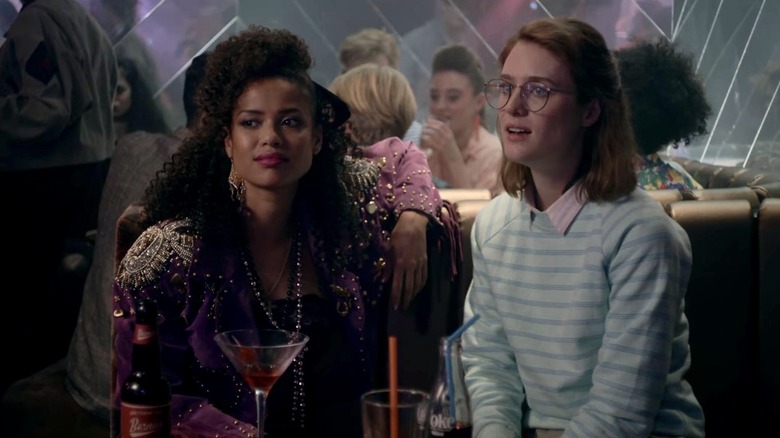
- A highly polysemic mode of address is constructed through the establishment of two separator eras, which is made explicit through a satisfying plot twist approximately halfway through the episode.
- The MES of the lighting is highly distinctive, with highly saturated reds and blues. Often referred to as ‘bisexual lighting’, the colour scheme evokes the LGBTQ= flag, in particular the bisexual colours, yet also is highly fashionable and evokes the time in which it was made (2016) AND makes nostalgic reference to an idealised, hyperreal 1980s setting
- However, the colour scheme and the soundtrack combine to construct a highly nostalgic mode of address. While many audiences will not have first hand knowledge of the 1980s, they will have complex reactions and negotiations of a glorified and idealised version of the 1980s
- A glorified and idealised version of the 1980s, that presents a powerful escapist fantasy to the target audience
- Pastel pink clothing of the main character has queer connotations, yet is also traditionally feminine, and conversely rejects hegemonic attitudes towards female attractiveness
- The episode makes extensive use of character archetypes predominantly from 80s teen films, including The Breakfast Club, Grease, The Goonies, Ferris Bueller’s Day Off, Pretty In Pink…
- Is this a dystopia or a utopia? The episode encourages audiences to negotiate this thorny issue
- San Junipero is a simulation, and everyone has a different perspective on this hypothesis
- Combination of science fiction and romance constructs an interesting mode of address and allows the episode to target a wider audience
- Black Mirror is an anthology show with a series of self-contained narratives
- A highly emotional mode of address is constructed through themes of love, and the struggle between reality and a simulation
- San Junipero is a construction based on nostalgic images from films set in and filmed in the 1980s
- Lacks many of the conventions of the sci-fi genre, including special effects, aliens, spaceships…
- Simulation - a reconstruction of reality that has been created from scratch.
- Examples of video games that feature detailed simulation include Assassin’s Creed, The Sims, Grand Theft Auto, Watchdogs and Cyberpunk
- Within the context of the diegesis of this episode, the consciousness of individuals can be uploaded to the cloud, digitised, and then allowed to ‘live’ in perpetuity
- Beyond the initial concept, the episode is surprisingly light on science fiction details
Wednesday, 1 November 2023
Black Mirror - San Junipero - initial analytic discussion
Friday, 13 October 2023
Exploring Hammer Horror film posters
Hammer Film Productions
Hammer is a British film production company that was first established in 1934. While Hammer have made films in a variety of genres, they are most well known for their particular British brand of Gothic horror cinema, many of which are considered classics of the genre. Featuring classic (and more importantly out of copywrite) characters such as Frankenstein's monster, Count Dracula, werewolves and zombies, Hammer pumped out many films in a very short period of time, often featuring big, bankable stars such as Christopher Lee and Peter Cushing, as well as a rotating cast of young women such as Ingrid Pitt and Madeline Smith, typically playing supporting roles. Towards the end of the 60s and especially into the 70s, Hammer films came under stiff competition from more violent and original films from America. Hammer struggled to adapt, adding more comedy and erotic elements to their horror films, before they ceased production in the 1980s. Many years later, the studio found success with The Woman In White and a few other minor hits.
Hammer horror posters
In order to contextualise the poster to Kiss Of The Vampire (1964) properly, it is essential to explore other theatrical posters for Hammer horror films.
Check out this Guardian article from 2010, and make notes under the following bullet points
- What are the genre conventions of the gothic horror film?
- How did Hammer ensure such success for such a long period of time?
- In what ways is gender represented in these posters?
- In what ways is ethnicity represented in these posters?
- Can we problematise these posters? How?
Friday, 6 October 2023
Exploring complex representations of disability in the Super.Human. 2020 Paralympics advertisement
Far from simply representing disabled people in a stereotypical way, the Super.Human promotional video instead represents disabled people as complex, flawed and highly diverse. For example, one representation of a disabled woman is of a mother, and the advert chooses to show her in a particularly unflattering and even upsetting manner. The upsetting audio of the woman screaming in agony, is anchored through the disorientating and upsetting fast paced editing. The harsh, cold, artificial lighting of the birth scene reinforces the harsh realty faced by disabled mothers and mother in general in the UK. Furthermore, the mid shot of the woman's screaming face, coupled with the MES of the sweat pouring down her forehead functions as a powerful symbolic code, that suggests the pain felt by mothers giving birth is equal to that of a disabled elite athlete training. The ideological perspective of the advert is that in order to be powerful, both para-athletes and mothers are extraordinarily strong as they endure unimaginable pain. Therefore, the advert underlines how powerful this group truly are, and demands greater respect.
While the Super.Human presents a range of complex representations of people disabilities, to also provides a more generalised representation that both a disabled and a broader audience may be able to relate to and identify .The woman in a wheelchair is not only represented through her disability, but also her status as an athlete, a white woman, working class and facing problems. By presenting a generalised and broad representation, the advert seeks to normalise her disability. The sense of relatability is constructed through the low key natural lighting, which constructs a stereotypical representation of living in the UK. This is further anchored through the MES of the wet concrete floor and the weeds sprouting out of the doorstep. This combination of media language constructs the UK as a sad and miserable place Furthermore, it functions as a symbolic code, suggesting the depression and adversity faced by the para-athletes in the advert. Moreover the doorstep functions as a binary opposition, and emphasises the hypocrisy of a powerful and strong woman who is unable to go into a local cafe. This setting infers that both local business and the UK government in general are not doing enough to include people with disabilities, and draws attention to a hard hitting issue for more general audiences. By drawing attention to a very specific issue faced by disabled people, the producer seeks to draw attention to this issue, and to challenge the population of the UK to be more accommodating to disabled people who are otherwise just like them
Super.Human: contextual information and prompts for further analysis
Contextual information provided by the exam board
The advertisement Super. Human. was created to promote the 2020 Paralympic Games by Bradford Young, the Oscar nominated cinematographer and the first African American cinematographer to be nominated for an award in 2017 for his work on the film Arrival [Michael's note: you should watch Arrival, it's an amazing film]
It was devised and created by Channel 4’s inhouse creative agency 4Creative and produced by Serial Pictures and Somesuch, a global production company. The trailer is the third campaign for the Paralympics undertaken by Channel 4, who were broadcasting the event, and was part of a bigger campaign including posters and social media.
The advertisement explores the sacrifices made and the trials endured by Paralympic athletes in preparation for the 2020 Tokyo Paralympic Games.
Image prompts for analysis
Monday, 2 October 2023
First year three hour ultra session: Super.Human analysis and advert design
This is a session of two parts! The first part is about ANALYSIS and the second part is about CONSTRUCTING REPRESENTATIONS. Let's get stuck in.
This is a self-directed lesson. It should be straightforward if you follow it through step by step. It is a lot of work and should take three hours to complete in total. If there are any bits you are struggling with, just skip it and move on to the next bit.
Please submit your finished work to your blog, if possible.
Part one: Super.Human analysis - 1 hour and 25 minutes
You can find this trailer by clicking here
1a) Watch the Super.Human video. Leaving aside any talk of analysis or media language? What are your honest thoughts? Write them down!
1b) Using screencap, select five images from the advertisment, and analyse/label/bullet point them using the following headings:
- Binary oppositions
- Proairetic codes
- Hermenutic codes
- Symbolic codes
- Camera work – framing, shot types, angle, position, movement
- Editing – pace, type of edits, continuity/montage (this is difficult to do for a still image, so please describe this image's place within the montage)
- Narrative
- Sound – music/dialogue/voiceover
- Mise-en-scene – colour, lighting, location, costume/dress, hair/make-up